Bronze vs. Brass Metallurgy: Chemical Composition and Environmental Performance
Bronze is an alloy of copper and tin engineered for outdoor permanence, naturally forming a protective oxide patina that resists coastal salt and harsh weather. Brass is an alloy of copper and zinc that delivers a brilliant golden tone ideal for luxury interiors, but tarnishes and suffers dezincification if exposed outdoors.
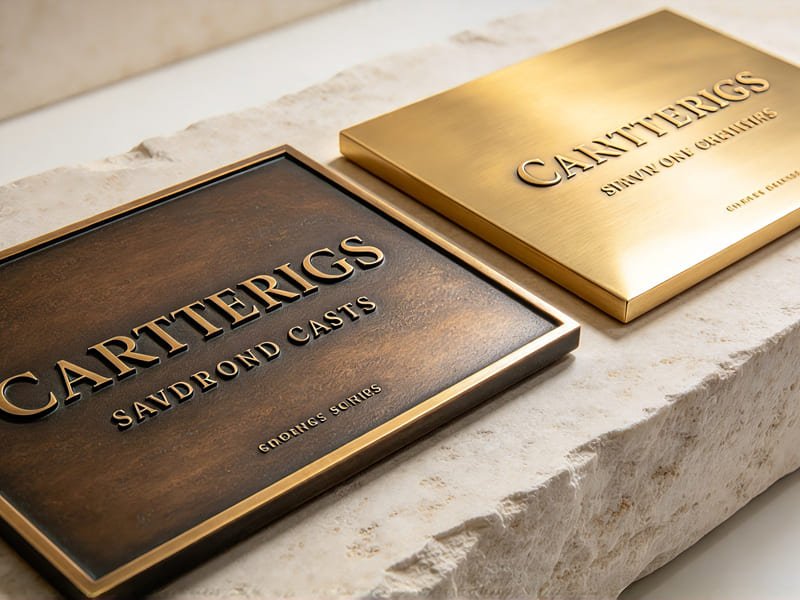
Before designing a custom plaque, you must understand the elemental metal resting at its core. While bronze and brass look somewhat similar when freshly polished, their elemental chemistry creates completely different physical reactions when exposed to rain, sunlight, and atmospheric moisture.
Bronze Chemistry: Copper-Tin Alloys (NAVY-G-88-8-04 and C92200)
True architectural bronze is primarily an alloy of copper and tin. Traditional foundry standards, such as government specification NAVY-G-88-8-04 or Unified Numbering System alloy C92200, utilize a mix of roughly 88 percent copper, 8 percent tin, and 4 percent zinc. Tin is the critical element. It gives bronze its exceptional structural hardness, high tensile strength, and resistance to environmental fatigue.
Because bronze contains no iron, it physically cannot rust. Under standards established by ASTM International, cast bronze displays outstanding resistance to friction and atmospheric degradation. When cast bronze is installed outdoors, it withstands decades of freezing winters, driving rainstorms, and salty ocean air without flaking or losing structural strength. For a broader look at how different architectural metals perform, review our comprehensive exterior signage metal materials guide.
Brass Chemistry: Copper-Zinc Dynamics and the Risk of Dezincification
Brass belongs to a different metallurgical family. Instead of tin, brass is created by combining copper with zinc, typically in a ratio of 60 to 70 percent copper to 30 to 40 percent zinc. Zinc gives brass its signature warm, golden yellow color, resembling polished gold at a fraction of the cost.
However, zinc is chemically reactive. When brass plaques are placed outdoors in wet, humid, or coastal environments, they suffer from a degradation process called dezincification. Moisture and acidic air leach the zinc atoms out of the alloy. This leaves behind a porous, brittle copper layer that quickly darkens into a blotchy, dull black tarnish. While brass can be protected with automotive clear coats, any pinhole scratch in the coating allows moisture to enter, turning the surrounding metal black. For this reason, architectural brass is primarily recommended for climate-controlled indoor spaces, luxury executive offices, and formal hotel reception walls. For a deeper technical comparison, consult our dedicated analysis on bronze vs. brass signage and plaques.
Natural Patination: The Living Surface vs. Destructive Corrosion
When outdoor materials age, we usually think of decay. Carbon steel rusts away, and plastics crack under solar heat. Bronze behaves differently. When exposed to rain and oxygen, bare bronze naturally forms a thin, stable chemical barrier composed of copper oxides and copper carbonates. This layer is known as patina.
Far from being a defect, patina acts as an armor shield that permanently seals the underlying metal from further corrosion. Over decades, an outdoor bronze plaque slowly shifts from warm statuary brown to a soft, distinguished greenish-brown verdigris. Agencies like the National Park Service celebrate natural bronze patina as a mark of authenticity and historical longevity.
| Metallurgical Metric | Cast Architectural Bronze (C92200) | Architectural Brass (C36000) | Cast Aluminum (Alloy 365) |
|---|---|---|---|
| Primary Chemical Makeup | 88% Copper, 8% Tin, 4% Zinc | 65% Copper, 35% Zinc | Silicon-Magnesium Aluminum |
| Density (Weight per cu. in.) | 0.312 lbs/cu.in (Heavy) | 0.305 lbs/cu.in (Heavy) | 0.097 lbs/cu.in (69% Lighter) |
| Melting Point | 1,810°F (988°C) | 1,650°F (899°C) | 1,220°F (660°C) |
| Outdoor Weathering Reaction | Forms stable, protective patina | Tarnishes dark; dezincifies in moisture | Forms invisible gray oxide film |
| Optimal Environment | Permanent outdoor monuments, facades | Luxury interior offices, donor walls | Budget-conscious civic signs, wayfinding |
| Relative Cost Factor | Premium Standard ($$$$) | Premium Interior ($$$$) | 20% to 40% Less than Bronze ($$) |
The Foundry Floor: The Multi-Step Sand Casting Process
Manufacturing cast bronze plaques involves crafting a master pattern, pressing it into bonded sand to form a negative mold, and pouring molten bronze at over 2,000 degrees Fahrenheit. Once cooled, artisans break the mold, chase the metal edges, apply chemical patinas, hand-highlight raised letters, and apply clear coats.
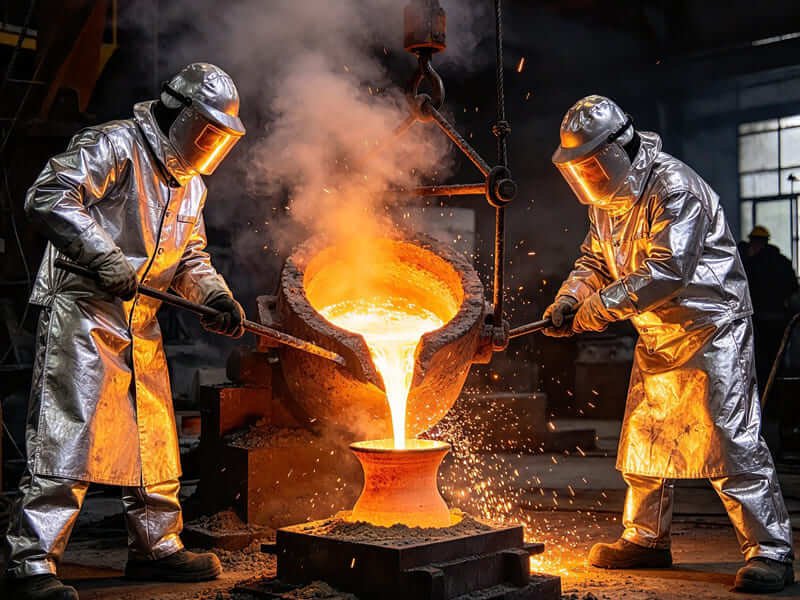
While modern technology has revolutionized pattern layout and vector drafting, the actual creation of a cast plaque remains an authentic, hands-on foundry craft. Pouring liquid metal into packed sand captures rich textures and heavy relief that simple machine engraving can never recreate.
Master Patterns, Shrinkage Ratios, and 3D Modeling
Every casting starts with a pattern, which is an exact positive model of the finished plaque. Historically, patternmakers carved letters by hand out of wood. Today, technicians use precision CNC routers and high-resolution 3D printers to mill patterns from dense polyurethane tooling boards. Every letter, border profile, and emblem is modeled with extreme accuracy.
Foundry patternmakers must account for volumetric contraction. As molten metal transitions from a 2,000-degree liquid into a solid metal plate, it shrinks. To compensate, the CAD software scales the master pattern up by approximately 1.5 to 2.0 percent. Furthermore, every raised letter and border must incorporate a draft angle, which is a slight 2-to-3-degree bevel along its vertical walls. Without this draft taper, the pattern would drag against the sand when lifted out, crumbling the crisp edges of the mold cavity.
Chemical-Bonded Sand Molds and Pouring Molten Metal at 2,000°F
Once the pattern is ready, it is placed inside a heavy two-piece metal frame called a flask. Skilled molders pack the flask with ultra-fine olivine or silica sand mixed with a chemical bonding agent. This bonded sand packs tightly, capturing microscopic textures like fine leatherette grains and subtle letter serifs. The pattern is then lifted out, leaving a hollow negative cavity in the hardened sand.
Next comes the pour. Pure ingots of bronze are heated inside ceramic crucibles within gas or electric induction furnaces, reaching temperatures over 2,000 degrees Fahrenheit (1,100 degrees Celsius). Glowing bright orange-gold, the molten bronze is skimmed of slag and poured smoothly into the sand mold. The liquid metal rushes through carved channels, filling every crevice of the lettering before vents allow superheated gases to escape. Learn more about metal casting versus billet machining in our guide to cast vs. precision-tooled vs. etched plaques.
Mechanical Chasing, Gate Removal, and Sandblasting
After the bronze cools and solidifies, workers break apart the sacrificial sand mold, revealing a dark, rough casting. This raw casting now enters the hands of skilled foundry chasers. Technicians cut away the metal pouring sprues and runners using band saws, grind parting lines smooth, and hand-file letter perimeters to eliminate microscopic casting burrs.
The entire plaque is then placed in a sandblasting cabinet. Blasting the face with fine-grain abrasive media strips away residual mold sand and heat scale, leaving a clean, uniform metal surface ready to accept chemical patinas and protective clear coats.
Dimensional Relief and Proportions: Thickness, Depths, and Scaling Rules
Cast bronze plaque thickness is dictated by total surface area to prevent warping during cooling. Standard rim depths scale from 5/16 inch for small desk markers up to 1.5 inches for civic monuments. Raised characters rise 1/32 to 1/8 inch above the background, ensuring crisp tactile legibility.
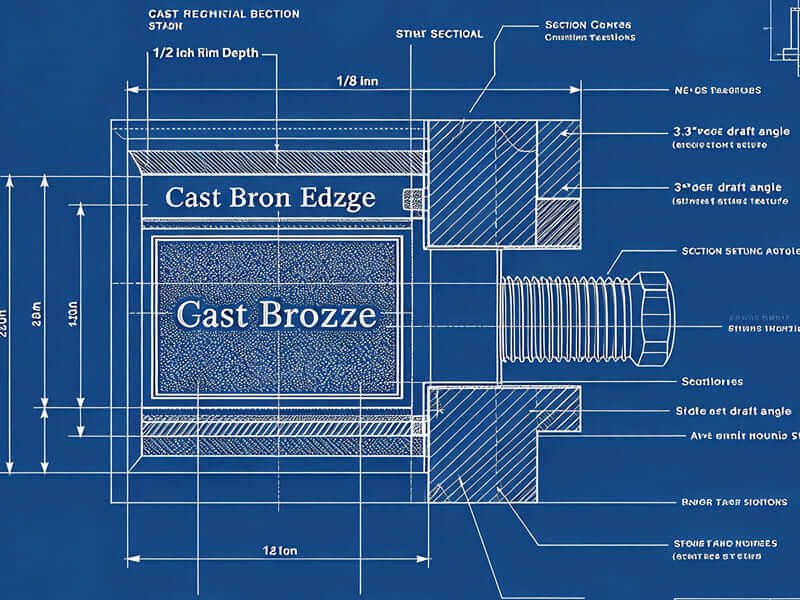
A cast bronze plaque is a substantial physical object with real structural depth. When specifying a plaque on architectural elevation drawings, architects must match the total surface area to the proper perimeter rim depth. If a plaque is cast too thin for its width, the cooling metal will warp inward during solidification.
Plaque Surface Area to Rim Depth Standards (5/16″ to 1.5″)
Foundries utilize standardized depth tiers based on square-inch surface area. As documented by industry leaders like Gemini, standard perimeter rim depths scale according to strict structural thresholds:
- Up to 323 Square Inches (e.g., up to 18×18 Inches): Cast with a nominal 5/16-inch perimeter depth. The backplate measures roughly 3/16 inch thick, creating a lightweight, rigid plate for small memorials and desk displays.
- 324 to 575 Square Inches (e.g., 20×24 Inches): Cast with a 1/2-inch perimeter depth. This is the standard commercial building marker depth, providing substantial visual presence on brick or stone walls.
- 576 to 1,295 Square Inches (e.g., 24×36 to 30×40 Inches): Cast with a 3/4-inch perimeter depth to resist thermal expansion and wind forces on civic monuments.
- 1,296 to 3,599 Square Inches (e.g., 36×48 to 48×72 Inches): Cast with a full 1.0-inch perimeter depth. Required for large institutional dedications and university entrance walls.
- 3,600 Square Inches and Larger: Poured with a heavy-duty 1.5-inch perimeter depth, incorporating internal structural reinforcing ribs along the back face.
Relief Lettering Heights, Stroke Widths, and Draft Angles
In casting terminology, letters are not printed; they are solid metal plateaus rising out of the textured floor. Characters typically project 1/32 to 1/8 inch from the background. To guarantee that molten metal flows smoothly into every character, letters must adhere to minimum typographic rules:
- Minimum Letter Height: All-caps Roman lettering should stand at least 0.375 inches (3/8 in) tall. Lowercase text should measure at least 0.50 inches tall. Smaller lettering risks crumbling the delicate sand mold during pattern lifting.
- Minimum Stroke Thickness: Letter line strokes must measure at least 0.050 inches thick. Hairline serifs will block the flow of molten bronze, causing cold-shut voids where letters fail to form completely.
Bas-Relief Sculptural Portraits vs. Photo-Engraved Inserts
Memorial plaques often honor key figures with visual portraits. Foundries achieve this using two distinct artistic techniques:
- Bas-Relief Sculptural Portraits: A master artist sculpts a physical clay portrait based on photographs. The clay portrait is cast directly into the solid bronze plaque, rising 1/2 to 1 inch above the face with stunning anatomical depth and artistic dignity.
- Photo-Relief / Etched Metal Inserts: A digital photograph is half-tone screened and chemically etched into a solid copper, brass, or stainless steel medallion. The etched portrait disc is set flush into a precision-cast recess in the plaque face. This method is faster and significantly less expensive than clay sculpture while capturing photographic realism.
| Surface Area Tier | Typical Dimensions | Standard Rim Depth | Letter Relief Height | Estimated Bronze Weight |
|---|---|---|---|---|
| Small Memorial (Up to 323 sq in) | 12″ × 18″ (216 sq in) | 5/16 Inch (7.9 mm) | 1/32 to 1/16 Inch | 12 to 18 lbs |
| Standard Building Plaque (324 to 575 sq in) | 20″ × 24″ (480 sq in) | 1/2 Inch (12.7 mm) | 1/16 to 3/32 Inch | 25 to 35 lbs |
| Civic Dedication (576 to 1,295 sq in) | 24″ × 36″ (864 sq in) | 3/4 Inch (19.0 mm) | 3/32 to 1/8 Inch | 45 to 65 lbs |
| Large Institutional (1,296 to 3,599 sq in) | 36″ × 48″ (1,728 sq in) | 1.0 Inch (25.4 mm) | 1/8 Inch (3.2 mm) | 85 to 130 lbs |
| Monumental Landmark (3,600+ sq in) | 48″ × 96″ (4,608 sq in) | 1.5 Inches (38.1 mm) | 1/8 to 3/16 Inch | 220 to 350+ lbs |
Architectural Background Textures and Border Profiles
Background textures add visual contrast and conceal surface smudges behind raised lettering. The five standard architectural textures include stipple, leatherette, sand, pebble, and classic leather. Borders frame the composition, ranging from clean single-line bevels to ornate classical rope and custom sculpted crests.
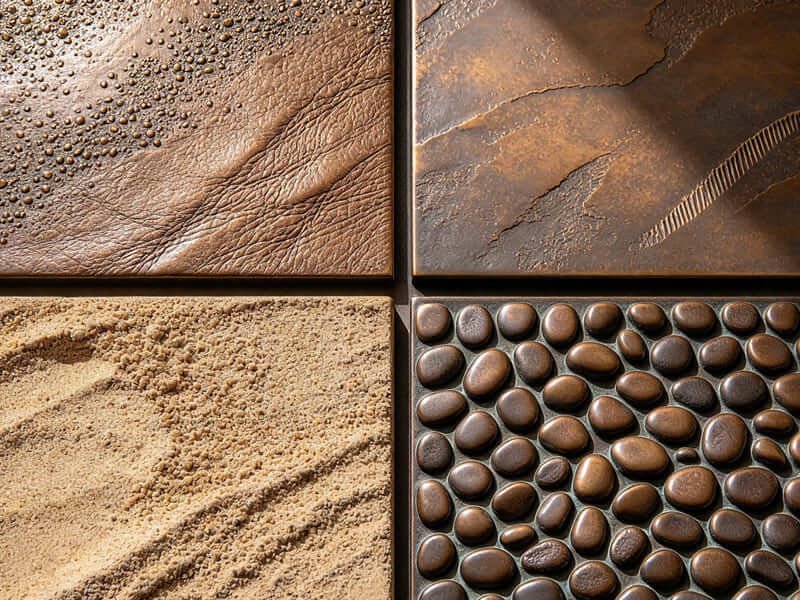
In casting design, the background is not empty space; it is an active design element. Casting a large plaque with an entirely smooth, mirror-flat background is impractical because molten metal leaves tiny grain swirls. Casting an intentional background texture creates depth, hides casting variations, and makes golden raised letters pop with incredible contrast.
The Five Standard Background Textures: Stipple, Leatherette, Sand, Pebble, and Classic Leather
Foundries cast textures directly into the metal floor:
- Stipple Texture: The universal workhorse of the plaque industry. It features a dense, finely stippled pebbled surface that disperses light evenly. It hides casual fingerprints and minor surface scuffs, making it the top specification for public buildings and parks. Available on castings up to 84 inches.
- Leatherette Texture: A cross-hatch, woven grid texture resembling fine Moroccan leather. It conveys an executive, formal feel and is widely specified for university donor walls, corporate headquarters, and legal memorial libraries.
- Sand Texture: The smoothest textured surface available, mimicking damp beach sand. It delivers a modern, minimalist look. However, because it is smooth, it shows handling smudges more easily than stipple.
- Pebble Texture: A rougher, rounded stone texture that evokes natural river rock. It is favored for outdoor nature centers, botanical gardens, and rugged national park trail markers.
- Classic Leather Texture: A vintage, deeply aged leather grain. Restricted to plaques under 28 by 48 inches, it is frequently chosen for historical restorations and brownstone landmark entries.
Standard Architectural Borders: Single Line, Beveled Edge, Ogee, and Rope
Borders frame your message like a picture frame, defining the plaque’s architectural boundaries:
- Single-Line Border: A clean, raised flat border running around the perimeter. Simple, crisp, and contemporary.
- Beveled Edge Border: The outer rim slopes downward at a hand-sanded 45-degree angle. When highlighted to a satin shine, beveled borders catch ceiling light, creating a bright metallic outline that frames dark oxidized text.
- Ogee Border: An S-shaped architectural profile mirroring classical Roman limestone moldings. It adds historic gravity to civic hall dedications and public monuments.
- Rope Border: A continuous braided maritime rope relief. The standard specification for naval memorials, yacht club plaques, and coastal dedications.
Custom Sculpted Borders and Institutional Coats of Arms
For prestigious state capitols, universities, and federal institutions, foundries can cast custom sculpted bas-relief borders. Master patternmakers model state seals, oak leaf garlands, military crests, or corporate emblems directly into the perimeter frame. While custom sculpted borders typically add a 25 percent manufacturing upcharge, they create an extraordinary, one-of-a-kind ceremonial marker.
Surface Finishes and Patinas: From Golden Satin to Antique Statuary
Plaque finishes define the final color contrast between raised text and recessed metal. Standard finishes include satin-highlighted gold letters over dark oxidized statuary brown, brilliant mirror-polished faces for luxury interiors, and accelerated turquoise patinas for historic antiquing.
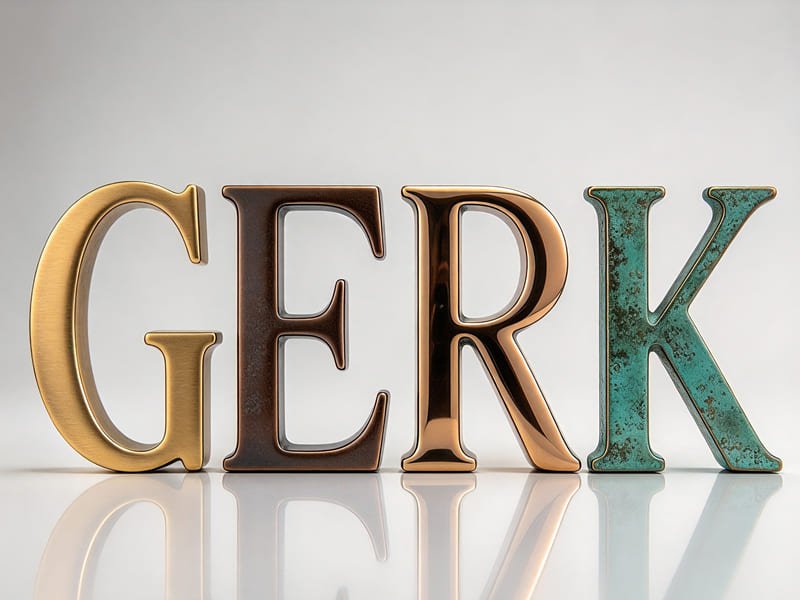
When a raw bronze casting emerges from the sandblasting booth, it is a pale, uniform pinkish-tan color. The rich colors associated with bronze plaques are created through chemical reactions and hand finishing.
Natural Satin Bronze Highlighting
The timeless standard for architectural plaques is satin-highlighted bronze. After the casting is sandblasted, artisans immerse the plaque in a chemical oxidizing solution that turns the entire surface a deep, rich brown or black. Once dried, the plaque is laid on a flat finishing table.
Skilled craftsmen use mechanical stroke sanders and hand-held sanding blocks running horizontal strokes across the face. The sander cuts away the dark oxide from the raised letters, border rims, and emblems, revealing the brilliant, golden raw bronze metal beneath. The textured background floor remains dark and untouched. This delivers stark visual contrast: golden lettering rising out of a dark, shadow-rich field.
Chemical Oxidizing: Dark Statuary Brown and Jet Black Contrast
The background color is created using chemical oxidizing baths, traditionally potassium polysulfide (liver of sulfur). The sulfur molecules react with surface copper atoms, instantly forming a micro-thin layer of copper sulfide. Controlling bath temperature and immersion timing produces two primary architectural shades:
- Statuary Brown: The historic municipal standard. A deep, chocolate brown tone that feels traditional, warm, and dignified.
- Jet Black: A contemporary, high-contrast finish. Black background coatings make golden satin lettering pop with maximum typographic clarity.
Polished Face and Beveled Edges: Aesthetic vs. Maintenance Trade-offs
Clients seeking maximum luxury can specify a polished face. Artisans take the highlighted raised letters through multiple buffing wheels charged with jeweler’s rouge, polishing the bronze to a mirror-like shine. A polished face carries roughly a 50 percent manufacturing upcharge due to extensive hand labor.
While polished bronze looks breathtaking in climate-controlled indoor lobbies, it is ill-suited for outdoor monuments. Direct sunlight bounces off polished letters, creating blinding glare that makes text illegible. Furthermore, polished bronze requires constant dusting and waxing to prevent visible finger smudges. A popular, tasteful alternative is specifying a polished beveled edge (a 20 percent upcharge). This frames a readable, satin-highlighted plaque within a gleaming golden border halo.
Accelerated Turquoise/Verdigris Patina: Antiquing for Heritage Sites
In nature, it takes thirty to fifty years of coastal rain and air exposure for bronze to develop the pale green crust known as verdigris. Foundries can accelerate this aging process artificially. Technicians spray the raw bronze with hot copper nitrate solutions, stippling the surface to grow a soft, chalky greenish-blue verdigris patina across the background.
Artisans then highlight the raised letters to a golden satin sheen. This gives a newly installed plaque the immediate character of an ancient monument that has stood guard since the 19th century. Accelerated patinas must be sealed with specialized clear coats to prevent the chalky green salts from washing away in the rain. To compare metal options, see our cast bronze vs. cast aluminum plaques guide.
| Finish Designation | Visual Appearance | Factory Finishing Method | Cost Upcharge | Maintenance Level | Optimal Environment |
|---|---|---|---|---|---|
| Satin Highlighted (Standard) | Brushed golden letters over dark brown | Chemical oxidation + mechanical stroke sanding | Baseline (Included) | Low (Annual wash & wax) | All exterior & interior installations |
| Jet Black Oxidized | Maximum contrast; black floor, gold letters | Deep chemical bath + hand highlighting | Baseline (Standard Option) | Low | Modern corporate & institutional walls |
| Polished Face | Mirror-like, high-reflection golden shine | Jeweler’s rouge buffing wheels | +50% Manufacturing Cost | High (Shows fingerprints) | Climate-controlled luxury lobbies |
| Polished Beveled Edge | Satin text with a mirror-shine perimeter rim | Precision hand-buffing of 45° border | +20% Manufacturing Cost | Moderate | Executive suites & donor walls |
| Turquoise Verdigris Patina | Aged antiqued green floor with satin text | Hot copper nitrate chemical spraying | +15% to 25% Upcharge | Medium (Avoid scrubbing) | Historic landmarks, botanical gardens |
Clear Coats, Protective Sealants, and Preservation Chemistry
Every cast bronze plaque requires an industrial baked clear sealant to protect highlighted lettering from air oxidation and preserve background patinas. Clear coats come in satin, semi-gloss, gloss, and matte sheens, with specialized formulations engineered for severe coastal or high-humidity installations.
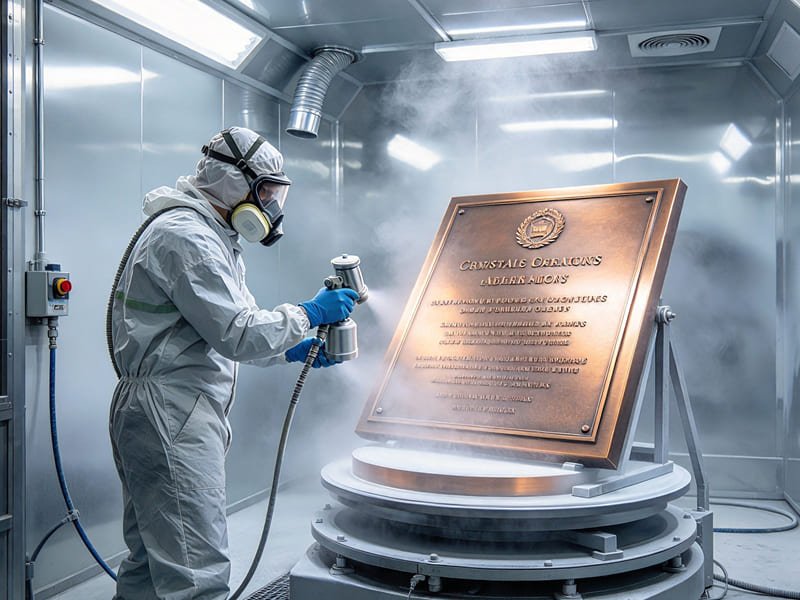
Raw highlighted bronze is pure bare metal. If you place raw highlighted bronze outside without protection, humidity and oxygen will tarnish the golden letters back to dark brown within weeks. The final factory step is applying an industrial clear sealant that locks the contrast in place.
The Role of Industrial Clear Sealants: Satin, Semi-Gloss, Gloss, and Matte
Foundries apply two-part industrial acrylic or polyurethane clear coats, baking them in convection ovens at 250 degrees Fahrenheit. The heat cures the liquid clear coat into an impermeable, cross-linked shield that bonds directly to the microscopic pores of the metal. Architects can select from four optical sheens:
- Satin Clear (Standard): The universal architectural choice. It protects the metal with a soft luster, suppressing glare while letting the natural metallic warmth shine through.
- Matte Clear: Delivers zero surface reflection. Crucial for indoor ADA-compliant directories where room lighting could cause glare.
- Gloss Clear: Formulated specifically for mirror-polished plaques. A high-gloss clear coat preserves the brilliant golden shine without clouding the mirror reflection.
Protective Formulations for Severe Coastal and High-Moisture Environments
When plaques are mounted in oceanfront parks, cemetery benches, or open trail posts, environmental moisture attacks the plaque from all directions. Sign specifiers can request an optional harsh-environment encapsulation clear coat.
In standard production, clear coat is applied only to the front face. In harsh environments, technicians coat all six sides of the plaque, including the back face and mounting stud bosses. Sealing the back of the plaque prevents moisture from getting trapped between the stone wall and the metal, stopping edge-lifting before it can start.
The Reality of Ground-Level Corrosion: Why Ground Insets Require Specialized Care
Almost every major foundry includes a strict warranty exclusion: clear coats on plaques installed flush in the ground are not warranted. Why? Because ground-flush cemetery markers sit directly in pooling mud, acid rain puddles, lawn fertilizers, and pet urine. Furthermore, grounds crews drive heavy motorized lawnmowers directly over flat markers, while string trimmers whip against the edges.
Chemicals and abrasive impacts strip clear coats rapidly. Ground-flush plaques should always be installed on raised, sloped concrete pads or beveled granite bases with gravel drainage channels beneath. To learn how to preserve park and memorial plaques, explore our memorial bench and garden plaques guide.
Typography, Layout Hierarchy, and Inscription Standards for Dedications
Plaque inscriptions must balance architectural dignity with legibility. Timeless dedication layouts follow a clear three-tier structure: identity, relationship, and commemorative meaning. Limiting copy to under thirty words, utilizing classic serif fonts, and leaving generous margins ensures readability from a distance.
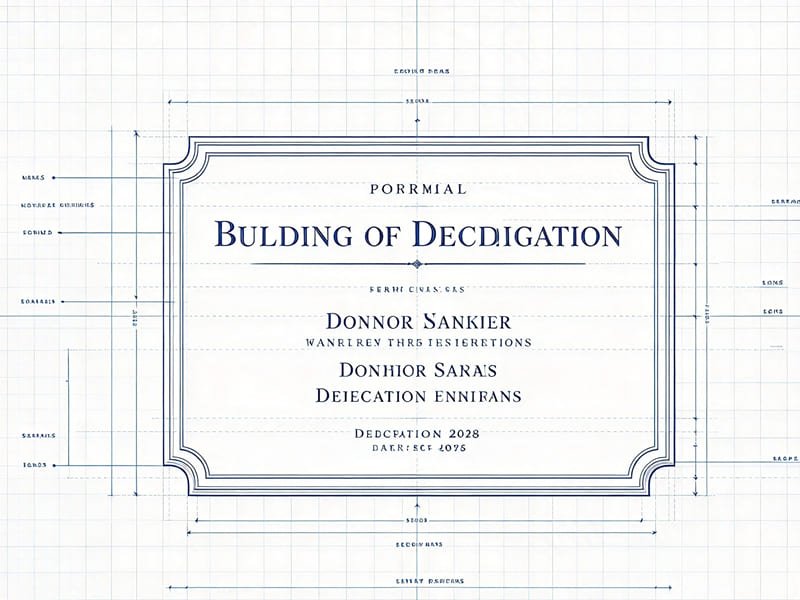
Designing a dedication plaque is a lasting exercise in storytelling. The words cast into molten bronze will outlive everyone in the room. Careful editing, proper margins, and disciplined typographic hierarchy ensure your tribute carries dignity across generations.
The Golden Rules of Dedication Wording: Identity, Relationship, and Meaning
The most common mistake building committees make is trying to fit an entire history book onto a single piece of metal. When you crowd hundreds of words onto a plaque, the font size shrinks, line spacing tightens, and the message blurs into an unreadable mass of metal. Enduring dedication plaques follow a disciplined three-tier hierarchy:
- Tier 1: Identity: The focal headline. This is the name of the facility, memorial honoree, or donor. It should feature the largest letter height and thickest relief (typically 1.0 to 2.5 inches tall).
- Tier 2: Relationship: Clarifies who the person was to the institution (e.g., Beloved Founder, Dedicated Physician, Civic Philanthropist). Scaled to roughly 50 to 60 percent of the title size.
- Tier 3: Commemorative Meaning: A concise statement of dedication, official opening date, or an inspirational inscription (e.g., Dedicated on this Day to the Pursuit of Truth and Healing). Keep this section under thirty words. For exact formatting guidelines, see our building dedication plaque wording standards.
Typographic Hierarchy: Serif Dignity vs. Sans-Serif Modernity
Font choice establishes the voice of the plaque:
- Classic Roman Serif (Times New Roman, Garamond, Trajan): The gold standard for civic monuments, historic universities, and churches. Roman serifs project authority, timelessness, and legal weight. All-caps formatting is the traditional convention for headline titles.
- Clean Sans-Serif (Helvetica, Futura, Arial): Delivers crisp modern legibility for biotechnology campuses, contemporary hospitals, and research facilities. Sans-serif letters feature uniform stroke weights that cast clean, minimal shadows.
Multi-Stakeholder Approvals: Governing Boards, Donors, and Historic Commissions
Because bronze casting is permanent, pre-production proofing must be thorough. Before a foundry pours metal, the layout proof must be formally signed off by all key stakeholders: architects, facilities directors, major family donors, and university boards. Correcting a typo on a paper proof costs nothing; correcting a misspelled donor name once 2,000-degree bronze has cooled requires re-making the pattern and pouring a brand-new casting. In designated historic zones, verify layouts with your local preservation commission.
Modern Architectural Integration: Weatherproof QR Code Memorial Plaques
Modern bronze plaques integrate physical permanence with digital storytelling through weatherproof metal QR code medallions. Laser-micro-engraved on marine-grade stainless steel or cast bronze inserts, these scannable markers allow visitors to open online archives, donor biographies, and multimedia memorials instantly.
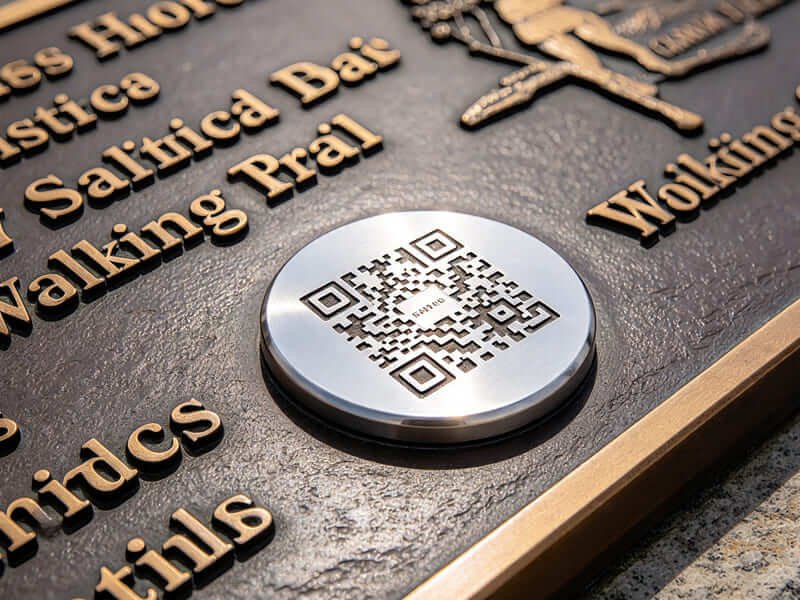
One of the most exciting innovations in modern architectural signage is bridging traditional foundry craft with digital cloud archives. A physical bronze plaque provides lasting physical permanence, but it is physically limited to thirty or forty words. By integrating a discrete, weather-sealed digital marker, an organization can preserve unlimited history.
Bridging Physical Bronze with Digital Archives
When a visitor approaches a historical walking trail marker or university memorial, they see a clean bronze plaque displaying the honoree’s name and dates. In the bottom corner rests a discreet two-inch metal medallion. The visitor points their smartphone camera at the code. Without downloading any mobile application, their phone opens a mobile webpage featuring archival video footage, historic speeches, audio walking guides, and full family genealogical histories. The physical plaque honors the memory; the digital portal tells the full story.
Laser-Micro-Engraved Marine-Grade QR Inserts
Why can’t foundries cast a QR code directly into sand molds? The physical surface tension of molten metal rounds off the sharp 90-degree corners of digital data modules, rendering directly cast QR codes unscannable by phone cameras.
The engineering solution is a precision hybrid medallion. Foundries cast a shallow circular or square recess directly into the bronze border. Technicians use precision fiber lasers to micro-engrave the QR matrix into a solid plate of Grade 316 marine-grade stainless steel or solid brass, utilizing fused ceramic compounds to produce jet-black, scannable contrast. The medallion is sealed flush into the bronze casting using industrial structural adhesives. For detailed layout ideas, explore our guide on weatherproof metal QR code memorial plaques.
Designing Hybrid Donor Walls and Historical Walking Trails
This hybrid approach is transforming university capital campaigns and city tourism. University donor walls can link physical donor tiles directly to live video profiles of students receiving scholarships. Municipal parks can create interactive walking trails where each historic marker acts as an educational gateway for students and tourists.
Mechanical Mounting Engineering: From Blind Studs to Freestanding Posts
Cast plaques must be mounted securely according to substrate and weight. Blind stud mounting with threaded rear studs set in epoxy is the tamper-resistant standard for masonry. Rosettes cover surface screws on interior walls, while stucco installations require spacers to prevent alkaline corrosion.
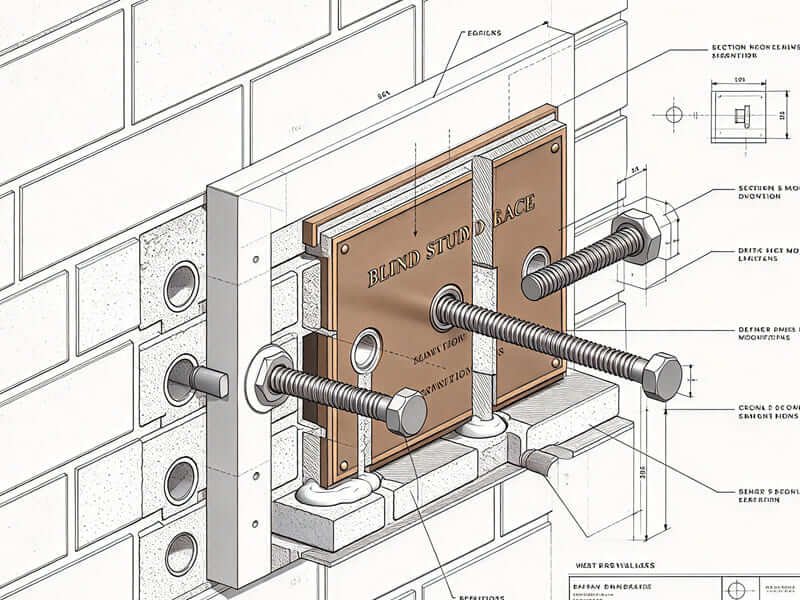
A 50-pound bronze plaque is only as dependable as the mechanical anchors securing it to the wall. Because bronze is heavy and valuable, proper installation guarantees that the tribute remains plumb, secure, and protected against vandalism.
Blind Stud (Concealed) Mounting: The Masonry & Concrete Industry Standard
Blind stud mounting is the premier installation method for exterior stone, brick, and concrete facades. During manufacturing, the foundry casts solid cylindrical bosses on the rear face of the plaque. These bosses are drilled and tapped to accept threaded stainless steel studs.
On site, installers tape a factory paper drilling template directly to the wall. Using a rotary hammer drill, they bore holes into the solid masonry, clean out brick dust, fill the holes with structural two-part epoxy, and slide the threaded studs in. Once the epoxy cures, the plaque is permanently locked to the building. There are zero visible screws, nuts, or pry points on the front face, making it virtually impossible for vandals to remove. Furthermore, this method satisfies International Building Code (IBC Appendix H) regulations requiring metal anchors embedded at least five inches into solid masonry. For step-by-step contractor guidance, read our tutorial on mounting bronze plaques on brick and concrete.
Rosette and Thru-Hole Screw Mounting for Interior Walls
When installing plaques on interior drywall, wood paneling, or historical surfaces where drilling deep holes is impractical, foundries drill countersunk mounting holes through the plaque corners. Installers fasten the plaque using matching wood or toggle screws.
To keep screw heads hidden, foundries supply decorative cast rosettes. Rosettes are ornamental bronze caps (available in domed, beveled, or floral relief) that cover the screw heads, preserving a finished, formal presentation. Thru-hole mounting allows easy removal if the plaque ever needs to be relocated during building renovations.
The Stucco Isolation Rule: Preventing Alkaline Lime Corrosion
If your plaque will mount onto an exterior stucco or synthetic EIFS wall, installers must observe a crucial chemical rule: bronze must never touch raw stucco. Stucco contains aggressive lime, Portland cement, and mineral salts. When rainwater enters behind the plaque, it leaches these salts, triggering an aggressive chemical reaction that pits the metal and ruins the clear coat.
Installers must slide nylon, neoprene, or stainless steel standoff spacers over each mounting stud behind the plaque. These spacers hold the metal 1/4 to 1/2 inch away from the stucco, creating an air gap that allows rainwater to drain freely down the wall.
Freestanding Post Mounts: Post-Cap Schedule 40 vs. Dual Square Steel Posts
For memorial gardens, cemetery plots, and historical walking trails lacking vertical walls, plaques are mounted on freestanding posts:
- Post-Cap Mounts (Schedule 40 Pipe): The foundry casts a round socket bracket as an integral part of the plaque’s rear face. This collar slides over a 1.5-inch, 2-inch, or 3-inch inside-diameter galvanized steel pipe, securing with recessed Allen set screws. Sized for plaques up to 900 square inches.
- Dual Square Steel Posts (2×2 to 4×4 Inches): For large civic monument plaques exceeding 900 square inches (such as 36 by 48 inch panels), dual structural square steel posts clamp to side-mount brackets, providing rigid wind-load resistance. Post footings must be poured in concrete extending below local frost lines.
| Mounting Hardware System | Visible Face Hardware | Compatible Wall Substrates | Maximum Plaque Size | Theft Resistance | Installation Accessory |
|---|---|---|---|---|---|
| Blind Stud Mount (Concealed) | None (Seamless Face) | Brick, solid stone, poured concrete | Unlimited (All Sizes) | Maximum (Tamper Proof) | Two-part structural epoxy & template |
| Screw Mount with Rosettes | Ornamental Rosette Caps | Drywall, wood studs, interior paneling | Up to 24″ × 36″ | Moderate | Wood screws or toggle bolts |
| Post-Cap Round Pipe Mount | None (Cast Socket Collar) | In-ground steel pipe (Schedule 40) | Up to 900 Sq. Inches | High (Recessed Set Screws) | 1.5″ to 3.0″ Galvanized steel pipe |
| Dual Square Steel Post System | Side / Rear Clamping Brackets | Freestanding in-ground concrete | Up to 60″ × 96″ | Maximum | 2×2 to 4×4 Structural square posts |
| Standoff Spacer Mount | None (Studs with Rear Spacers) | Exterior stucco, EIFS, rough stone | Unlimited | Maximum | Nylon or stainless isolation spacers |
Manufacturing Cost Drivers, Timelines, and Total Cost of Ownership (TCO)
Custom bronze plaque pricing is determined by surface area, rim depth, portrait modeling, and hand-applied finishes. Foundry sand casting requires four to eight weeks from approved artwork proof to delivery. While initial costs exceed aluminum or acrylic, bronze delivers the lowest hundred-year lifecycle cost.
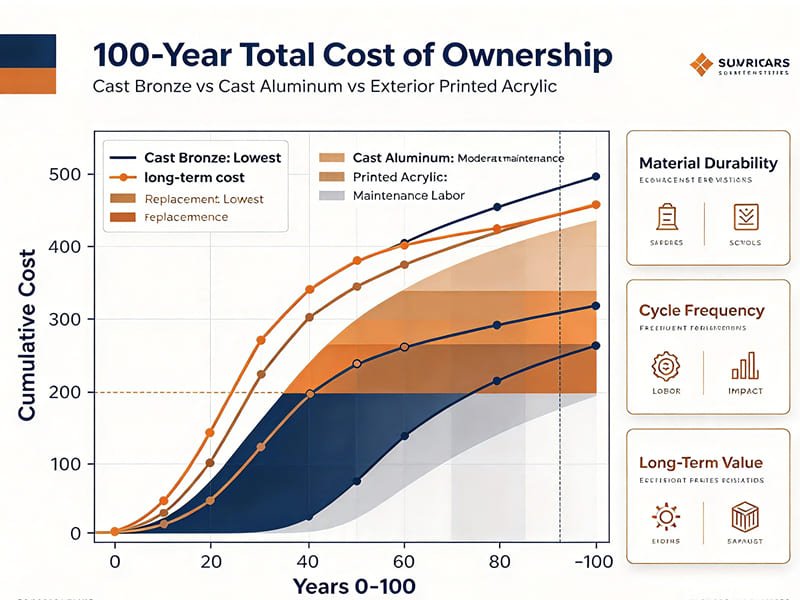
When building committees review a signage proposal, the initial quote for cast bronze can produce sticker shock. Sand-casting bronze is an energy-intensive, highly skilled manufacturing discipline. However, evaluating cost over decades reveals that cast bronze is the most economical architectural investment an institution can make.
Cast Bronze vs. Precision CNC Tooled vs. Chemically Etched Cost Breakdown
Plaque pricing is driven by materials and manufacturing hours:
- Cast Bronze Plaques: Pricing scales directly with surface area. Small niche markers (around 8 by 10 inches) range from $250 to $500. Standard building dedication plaques (such as 20 by 24 inches) typically land between $900 and $2,200. Large civic monuments (such as 36 by 48 inches) range from $3,500 to $6,500+. Adding custom three-dimensional bas-relief sculpted portraits adds $1,200 to $2,500 depending on artist modeling complexity.
- Precision-Tooled (CNC Billet) Plaques: High-speed CNC routers carve text out of solid aluminum or brass plate. This method is 15 to 25 percent less expensive than sand casting and cuts lead times in half, but produces shallower relief without authentic sand textures.
- Chemically Etched Plates: Acid dissolves thin metal to produce high-detail text and logos. Great for complex multi-line directories, but lacks dimensional rim depth. For a broader financial analysis, explore our custom business sign cost guide.
Casting Foundry Timelines: The 4-to-8-Week Manufacturing Cycle
Plaque casting cannot be rushed. It involves a sequential manufacturing chain:
- Weeks 1 to 2: Digital typesetting, scale layout proofing, client review, and final committee approval.
- Weeks 3 to 4: High-density pattern CNC milling, shrinkage scaling, sand mold packing, furnace melting, and pouring molten metal at 2,000°F.
- Weeks 5 to 6: Shakeout, gate sawing, pneumatic chasing, sandblasting, chemical patination, hand stroke-sanding, and baked clear coating.
- Weeks 7 to 8: Quality inspection, custom wooden crating, and insured freight delivery to the job site.
Long-Term Preservation and Maintenance Schedules
According to historic preservation standards documented by the U.S. General Services Administration (GSA), caring for bronze requires gentle stewardship rather than aggressive scouring:
- Semi-Annual Cleaning: Gently wash the plaque face using clean warm water, mild non-ionic liquid dish soap, and a soft microfiber cloth. Rinse thoroughly and pat dry.
- Annual Waxing: Apply a light coat of pure carnauba paste wax or microcrystalline wax to clean, dry bronze. Allow the wax to haze for fifteen minutes, then buff with a soft microfiber towel. The wax fills microscopic pores, sheds acid rain, and slows natural patina oxidation.
- Prohibited Methods: Never use steel wool, brass wire brushes, high-pressure power washers, or ammonia-based cleaners. These abrasive tools strip protective clear coats and scratch chemical patinas, requiring expensive on-site foundry restoration.
| Manufacturing Process | Typical Relief Depth | Minimum Letter Height | Production Turnaround | Photographic Capability | Outdoor Service Life |
|---|---|---|---|---|---|
| Sand-Cast Bronze Plaque | 5/16″ to 1.5″ Rim (Deep 3D) | 3/8 Inch (0.375″) | 4 to 8 Weeks | Bas-relief clay sculpt or etched insert | Centuries (Indefinite) |
| Precision-Tooled (CNC) Billet | 1/4″ to 1/2″ Plate (Shallow) | 1/4 Inch (0.250″) | 2 to 4 Weeks | Shallow vector linework engraving | 50+ Years |
| Chemically Acid-Etched Plate | 1/16″ to 1/8″ Sheet (Flat) | 1/8 Inch (0.125″) | 2 to 3 Weeks | High-resolution halftone etching | 25 to 50 Years |
Frequently Asked Questions About Cast Bronze & Brass Plaques
Find authoritative, factory-backed answers to eight common questions regarding cast bronze and brass plaques, including outdoor lifespan, bronze versus brass durability, casting timelines, cemetery regulations, repair methods, and weight engineering.
How long will a cast bronze plaque last outdoors?
A quality cast bronze plaque will easily last for centuries. Bronze is inherently corrosion-resistant and does not rust. While the factory clear coat will eventually wear off after 15 to 25 years, the underlying bronze simply matures into a protective, dignified patina that remains legible for generations.
What is the main difference between bronze and brass for plaques?
Bronze is made from copper and tin, making it tough, weather-resistant, and ideal for outdoor memorials. Brass is made from copper and zinc, which gives it a bright golden luster for luxury interior displays, but causes it to tarnish and discolor quickly when exposed to outdoor rain and humidity.
How long does it take to manufacture a custom cast bronze plaque?
Standard production takes four to eight weeks from the date the digital artwork proof is officially approved. This timeline allows for pattern milling, sand mold packing, pouring molten metal at 2,000 degrees Fahrenheit, cooling, metal chasing, chemical patination, and oven-cured clear coating.
Can a cast bronze plaque be installed flat on the ground?
Yes, but foundries do not warrant clear coats on plaques installed flush in the ground. Constant exposure to lawn fertilizers, pet urine, weed trimmers, and standing puddles rapidly strips protective sealants. Ground-mounted plaques should be mounted on sloped granite or raised concrete footings with gravel drainage.
What is the best way to clean and maintain a bronze plaque?
Wash the plaque once or twice a year using clean warm water, mild non-ionic liquid dish soap, and a soft microfiber cloth. Rinse thoroughly and pat dry. Apply a light coat of pure carnauba paste wax annually to seal the metal pores. Never use abrasive scouring pads, wire brushes, or ammonia cleaners.
How are cast bronze plaques mounted to brick or stone walls?
The industry standard is blind stud mounting. Threaded metal rods are screwed into tapped bosses on the back of the plaque, inserted into matching holes drilled into the masonry, and locked permanently in place using two-part structural epoxy. This leaves zero visible hardware on the front face.
Can photographs of people be included on a cast bronze plaque?
Yes. Photographs can be rendered as traditional three-dimensional sculpted bas-relief portraits modeled by a master artist, or as high-resolution photo-etched metal medallions embedded flush into the plaque face.
How much does a custom cast bronze building dedication plaque weigh?
Bronze is dense, weighing approximately 0.31 pounds per cubic inch. A standard 1/2-inch deep building dedication plaque measuring 20 by 24 inches weighs between 25 and 35 pounds, while a 24 by 36 inch plaque weighs 45 to 65 pounds, requiring heavy-duty masonry anchors.
Casting Your Legacy in Architectural Bronze
A custom cast bronze plaque is the ultimate statement of permanence, honor, and architectural dignity. As we have explored throughout this guide, commissioning a plaque is not merely an artistic purchase; it is a permanent structural investment. By selecting true copper-tin bronze for outdoor legacy, matching plaque surface areas to engineered rim depths, specifying hand-rubbed statuary patinas, and utilizing International Building Code compliant blind stud mounts, your institution ensures that its milestone dedication stands proud and legible for centuries to come.
Whether you are dedicating a modern healthcare pavilion, honoring fallen service members, recognizing major capital donors, or marking an ancient historical landmark, true quality begins on the foundry floor. At Custom Signages Factory, our master patternmakers and foundry artisans combine modern 3D CNC digital sculpting with traditional sand-casting techniques. We pour certified, lead-free architectural bronze and aluminum alloys, applying authentic hand-rubbed patinas and baked protective clear coats under one roof.
Do not leave your institution’s permanent legacy to guesswork. Contact the engineering and architectural team at Custom Signages Factory today to discuss your dedication project, request physical finish samples, review digital layout proofs, and receive a comprehensive manufacturing estimate for your custom plaque.