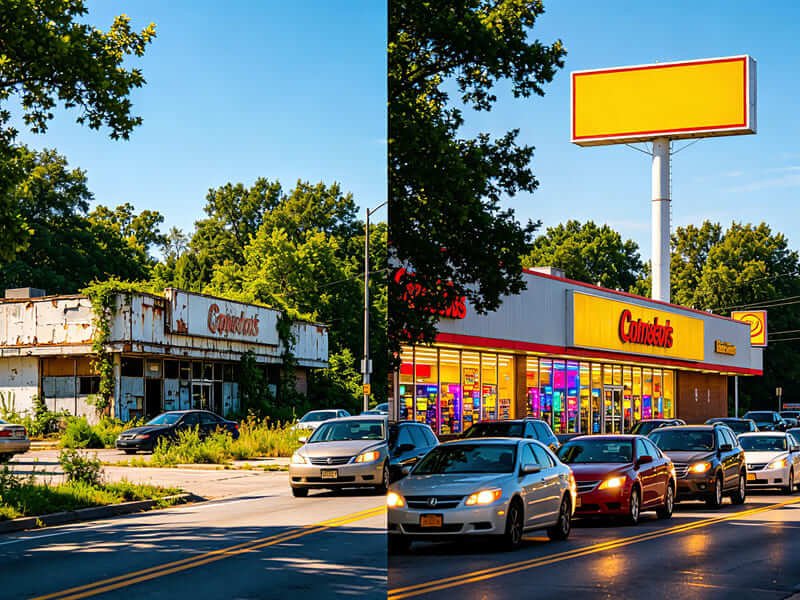
Did you know that roughly 76 percent of consumers have walked into a commercial facility for the first time simply because an attractive sign caught their eye? Even more telling, 68 percent of customers firmly believe that the physical appearance of an establishment’s signage reflects the overall quality of its products and services. In commercial environments, your exterior sign is your most persistent brand ambassador. It stands guard through blistering summer heatwaves, driving rainstorms, and freezing winter winds, constantly signaling your company’s professionalism. Yet, many property managers, general contractors, and business owners invest in premium rust-proof aluminum, only to watch their graphics fail prematurely.
Picture two common commercial sign failures. In one parking lot, an outdoor metal sign features a vinyl graphic whose edges have shrunk, curled, and peeled away from the metal plate like sunburned skin, leaving dirty adhesive lines behind. Just down the street, an adjacent building sign has stayed flat, but its once-vibrant red corporate logo has faded into a chalky, washed-out pink under five years of direct sunlight. What happened here? In both cases, the aluminum panel beneath is in perfect condition, but the graphic on top failed. The hard truth of modern signage manufacturing is that the metal substrate almost always outlives the printed graphic. The true battle for exterior durability is fought at the surface level: direct-to-substrate UV printing versus adhesive vinyl overlays.
Choosing the wrong graphic method for your specific climate and installation can turn an expensive investment into an eyesore within a few short seasons. This comprehensive engineering guide solves that problem. By examining ink chemistry, mechanical adhesive shear, ultraviolet pigment breakdown, and real-world maintenance costs, we help you evaluate direct UV printing against cast vinyl overlays. Whether you are engineering long-term building fascias, municipal roadway markers, or corporate interior directories, this guide gives you the factory-tested knowledge to specify the right graphic technology for your commercial property.
Table of Contents
The Manufacturing Split: How Each Technology Applies Graphics to Metal
Direct-to-substrate UV printing deposits liquid acrylic inks straight onto pre-coated metal panels, instantly polymerizing them into a solid plastic layer under ultraviolet lamps. Vinyl overlays involve printing graphics onto cast PVC film, protecting the film with a clear overlaminate, and mounting the adhesive film onto the metal using motorized pressure rollers.
To choose the right signage method, you first need to understand what happens inside the manufacturing plant. While both methods produce colorful graphics on aluminum panels, their physical structures and production workflows are entirely different. One creates an integrated ink-and-metal bond, while the other builds a multi-layered film laminate.
Anatomy of Direct-to-Substrate UV Flatbed Printing
Direct UV printing eliminates intermediate materials entirely. The process begins by placing a pre-cut aluminum sheet or composite panel onto a large flatbed printing table. Powerful vacuum pumps pull air through thousands of tiny holes in the table surface, clamping the metal sheet completely flat so it cannot shift even a fraction of a millimeter.
A heavy motorized carriage sweeps back and forth across the metal panel. Piezoelectric printheads jet microscopic droplets of specialized ultraviolet-curable ink directly onto the metal surface. These inks are not made with water or evaporating chemical solvents; they consist of liquid acrylic monomers, oligomers, and photoinitiators. Mounted directly beside the printheads are high-intensity UV-LED lamps. The instant the ink droplet strikes the metal, the ultraviolet light triggers a photochemical cross-linking reaction. The liquid monomers instantly link together, hardening into a solid, cross-linked plastic polymer film in less than a second. Because the ink cures instantly on contact, the sign comes off the machine dry, ready for immediate cutting, hole drilling, and packing with zero volatile organic compound (VOC) emissions. For an overview of how aluminum panels are prepared for this process, see our primary guide on custom aluminum signs and manufacturing.
Anatomy of Vinyl Overlay Graphics
The vinyl overlay method is an assembled multi-layer system. Instead of printing directly onto metal, the graphic is printed on an independent flexible film made of polyvinyl chloride (PVC). Once the ink dries on the vinyl roll, the printed film is fed through an industrial laminator, which applies a second layer: a clear protective overlaminate film that shields the ink from scratches and weather.
Finally, the combined vinyl-and-laminate sandwich is taken to a wide-format cold-roller mounting table. Technicians peel back the release liner to expose the pressure-sensitive acrylic adhesive on the back of the vinyl. Motorized silicone rollers press the film firmly against the aluminum panel, squeezing out air bubbles and establishing a mechanical adhesive bond. The sign must then be hand-trimmed around the edges with precision razor knives. This process creates a graphic with three distinct physical layers sitting on top of the metal: adhesive, PVC film, and clear overlaminate.
| Engineering Parameter | Direct-to-Substrate UV Printing | Cast Vinyl Overlay System |
|---|---|---|
| Graphic Layer Structure | Single cross-linked polymer ink layer | Three layers: adhesive, vinyl film, clear laminate |
| Bonding Mechanism | Chemical and mechanical bond to baked enamel | Pressure-sensitive acrylic adhesive layer |
| Physical Seams / Edges | Zero edges; ink is flush with panel surface | Exposed perimeter edge around entire graphic |
| Production Workflow | Single-pass automated flatbed printing | Multi-step: print, outgas, laminate, roll-mount, trim |
| Volatile Organic Compounds (VOCs) | Zero emissions (100% solids UV-cured ink) | Solvent-printed films require 24-hr outgassing |
| Turnaround Speed | Immediate; dry off the printing bed | Requires drying and multi-step manual assembly |
The Science of Graphic Adhesion: Why Signs Peel, Bubble, or Chip
Direct UV printing bonds mechanically to factory-baked polyester enamel, creating a seamless graphic with zero edges that can never peel or lift. Vinyl overlays rely on pressure-sensitive adhesives that can succumb to edge lifting, moisture penetration, and thermal shear stress between expanding metal and shrinking PVC film.
To understand why signs fail in the field, we have to look closely at adhesion mechanics. How does an image actually hold onto a piece of metal through years of freezing rain, summer heatwaves, and windstorms? When graphics fail, they fail because the physical bond between the graphic layer and the metal breaks down.
How UV Ink Bonds to Coil-Coated Baked Enamel vs. Bare Aluminum
A common misconception is that UV flatbed printers spray ink directly onto raw, shiny aluminum. If an inexperienced shop prints directly onto bare mill-finish aluminum, the sign is doomed from day one. Raw aluminum forms a natural, microscopic oxide film that prevents liquid ink from wetting the surface properly. The ink sits on top of this slick oxide layer, and within a single winter, wind and ice will cause it to peel off in large sheets.
Professional sign manufacturing relies on pre-painted coil-coated aluminum sheets. According to metallurgical standards documented by the Aluminum Association, raw aluminum coils are chemically cleaned, conversion-coated (alodized) to resist corrosion, and coated on both sides with a baked-on polyester enamel primer at the rolling mill. When UV ink droplets hit this factory-baked enamel, the ink bites into the microscopic pores of the coating. As the UV-LED light activates, the ink and the enamel cross-link together, creating an inseparable bond. There is no physical film layer sitting on the sign; the graphic becomes an integral part of the panel’s painted surface. To understand how panel thickness affects this structural bond, review our guide on aluminum sign gauges and thickness standards.
Why Vinyl Overlays Develop Edge-Lift, Shrinkage, and Air Bubbles
Vinyl overlays work through pressure-sensitive acrylic adhesives. When the vinyl is rolled onto the metal, the adhesive flows into the microscopic surface texture of the aluminum, creating a strong mechanical bond. Premium cast vinyl films, such as those engineered by 3M Commercial Solutions, perform reliably for many years. However, every vinyl graphic has a fundamental structural vulnerability: an exposed physical edge.
Because vinyl is a separate sheet laid over metal, it has a cut border running around the perimeter of the sign. Over time, environmental forces attack this edge:
- Edge-Lifting: Wind rushing across a building facade catches the microscopic lip of the vinyl edge. Microscopic dust and moisture wedge underneath the film, gradually neutralizing the adhesive and causing the corners to curl outward.
- Plasticizer Migration and Shrinkage: Lower-grade calendered vinyl contains chemical plasticizers to keep the plastic flexible. Sunlight and heat cause these plasticizers to evaporate over time. As the vinyl loses plasticizers, it shrinks, pulling back from the edge of the aluminum panel and leaving an ugly line of exposed, sticky adhesive that collects black dirt.
- Adhesive Outgassing Bubbles: If a vinyl graphic is printed using solvent inks and laminated too quickly without a full 24-hour outgassing period, trapped solvent gases expand under the summer sun, forming bubbling blisters across the sign face.
Mechanical Scratch Resistance: Cross-Linked Polymers vs. Vinyl Film Thickness
Both methods handle everyday contact differently. Direct UV-cured ink hardens into a dense acrylic shell with high surface hardness. It resists light scuffs, cleaning cloths, and windblown dust exceptionally well. However, because the ink layer is micro-thin, a sharp metal gouge (like an intentional key scratch or a scraping screwdriver during mounting) will slice right through the ink down to the metal base.
In contrast, a premium cast vinyl overlay paired with a thick cast laminate creates a combined protective barrier roughly 4 to 6 mils thick. This flexible plastic cushion absorbs blunt abrasions well. If tree branches scrape against an outdoor sign in windy weather, the clear laminate absorbs the scuffs, protecting the printed image underneath. However, once a cut vinyl edge is nicked or lifted, the damage tends to spread along the seam.
Environmental Weathering: Ultraviolet Radiation, Heat, and Moisture
Sunlight ultraviolet radiation is the primary cause of sign graphic failure. Unlaminated UV inks fade across three to five years as organic pigments break down, with red and orange fading first. Premium cast vinyl overlays protected with cast laminates shield pigments from UV light, lasting seven to ten years outdoors.
When an aluminum sign is installed outdoors, it enters a demanding battle against natural weathering. Three environmental forces attack sign surfaces constantly: ultraviolet photons from the sun, thermal expansion cycles from changing seasons, and moisture penetration from rain, humidity, and ice.
The Sunlight Wavelength Attack: How Photons Break Down Ink Pigments
Ultraviolet radiation is the ultimate enemy of outdoor signs. Solar UV-A and UV-B rays carry high-energy photons that bombard the sign surface. Over time, these energetic photons break the molecular bonds inside the color pigments of the ink, a chemical process known as photodegradation or photo-oxidation. When the molecular bonds break, the pigments can no longer absorb and reflect light correctly, causing visible color fading.
This fading follows a predictable chemical sequence. Organic pigments used to create magenta, bright red, orange, and yellow hues have weaker molecular bonds. They fade first. A bright red logo gradually turns orange, then light pink, and finally disappears. In contrast, inorganic pigments used for carbon black, titanium white, and copper phthalocyanine blues have robust molecular structures that survive intense UV exposure for more than ten years. Geographic location also accelerates this wear: a sign installed in direct southern sun in Arizona or Florida receives more than double the annual UV radiation of a sign in Seattle, cutting unlaminated graphic lifespans in half.
Thermal Expansion Shear: Metal vs. Polyvinyl Chloride
Outdoor temperatures fluctuate dramatically between cold winter nights and scorching summer afternoons. These temperature swings create severe mechanical shear stress between an aluminum sign panel and an adhesive vinyl overlay due to differential thermal expansion.
Aluminum expands and contracts at a rate of roughly 13 millionths of an inch per inch of length for every degree Fahrenheit of temperature change. However, flexible PVC vinyl expands and contracts at more than three times that rate. On an eight-foot commercial building sign, the aluminum panel and the vinyl film are constantly pulling against each other as temperatures rise and fall. Over hundreds of seasonal cycles, this tug-of-war strains the acrylic adhesive. Low-grade calendered vinyl will crack, split, or pull away at the corners under this shear stress. Premium cast vinyl handles thermal movement far better because its cast manufacturing process leaves the film dimensionally stable with zero built-in memory.
Moisture Intrusion and Freeze-Thaw Delamination
Moisture is the catalyst that accelerates vinyl failure. When rain falls on a vinyl-covered sign, capillary action draws water into the microscopic edge seam between the vinyl film and the metal sheet. In warm weather, this moisture weakens the adhesive. But in northern climates that experience freezing winter weather, trapped water becomes destructive.
When liquid water freezes, it expands by approximately 9 percent in volume. That trapped moisture along the vinyl edge acts like a microscopic hydraulic wedge. As it freezes and expands, it physically pries the vinyl film away from the aluminum plate. Repeated freeze-thaw cycles cause the film to lift further with every storm. Direct UV-printed metal signs are completely immune to freeze-thaw delamination because there is no edge seam; the cured ink and the factory-baked enamel coating form an unbroken, continuous surface that water cannot penetrate. Explore how different substrates resist these forces in our technical comparison of solid aluminum vs. Dibond ACM signs.
| Weathering Stress Factor | Unlaminated Direct UV Print | Direct UV with Clear Coat | Laminated Cast Vinyl Overlay |
|---|---|---|---|
| Direct Sunlight UV Resistance | Moderate (3 to 5 Years) | High (7 to 10+ Years) | Very High (7 to 10+ Years) |
| Thermal Expansion Stability | Superior (Zero Shear Movement) | Superior (Zero Shear Movement) | Moderate (Adhesive Stress) |
| Edge Moisture Delamination | Zero Risk (Seamless Face) | Zero Risk (Seamless Face) | Moderate to High at Film Edges |
| Coastal Salt-Air Tolerance | High (Resists Salt Pitting) | Very High (Completely Sealed) | High (Salt Can Degrade Edges) |
| Freeze-Thaw Durability | Immune to Frost Wedging | Immune to Frost Wedging | Edges Vulnerable to Ice Lifting |
| Realistic Outdoor Lifespan | 3 to 5 Years | 7 to 10+ Years | 7 to 10 Years (Cast Grade) |
Print Resolution, Color Vibrancy, and Fine Detail Rendering
Direct UV flatbed printing delivers superior fine-detail resolution up to 1,200 dpi, reproducing intricate multi-line directories, bar codes, and photographic gradients without physical film seams. Cut vinyl is restricted by mechanical blade cutting limits, making fine lettering below one-half inch difficult to weed and maintain.
While durability dictates how long a sign survives outdoors, visual resolution dictates how effectively it communicates with your audience. The aesthetic gap between direct UV printing and vinyl becomes obvious when viewing signage up close in corporate lobbies, retail storefronts, and architectural directories.
Native DPI, Drop Volumes, and Text Crispness
Modern industrial flatbed UV printers utilize advanced variable-drop grayscale printheads. These printheads jet variable ink volumes as small as 6 picoliters (six-trillionths of a liter). Operating at native resolutions up to 1,200 dots per inch (dpi), direct UV printers place microscopic ink droplets with surgical accuracy. This allows sign makers to reproduce tiny 6-point legal text on industrial equipment tags, intricate corporate logos with complex drop shadows, and sharp, scannable QR codes directly on metal plates.
Furthermore, because the flatbed machine prints all colors (cyan, magenta, yellow, black, and white) in perfectly synchronized passes on a stationary vacuum table, there are zero alignment or registration errors. Colors blend smoothly across subtle photographic gradients without the banding or dot-grain patterns that older printing technologies produced.
Edge Weeding Limits in Cut Vinyl vs. Micro-Drop Digital Ink
Cut vinyl graphics are produced on mechanical vinyl plotters using sharp drag knives or tangential blades. The plotter blade cuts through the vinyl film while leaving the silicone release liner intact. A human technician then manually weeds the graphic, peeling away all excess negative vinyl with tweezers or dental picks before applying application transfer tape.
This mechanical cutting process has strict physical limitations:
- Blade Radius Limits: A cutting blade cannot make an infinitely sharp inside corner; it leaves a microscopic radius where the blade pivots. Highly intricate script fonts or delicate corporate crests lose their crispness when cut from vinyl.
- The Weeding Nightmare: Letters smaller than one-half inch (12 mm) tall are extremely difficult for human technicians to weed without accidentally pulling the tiny dots of letters like “i” or the centers of “e” and “a” off the backing paper.
- Surface Contact Area Failure: Tiny cut vinyl letters have very little surface area. Because a quarter-inch cut vinyl letter has only a tiny dot of adhesive holding it to the metal, routine cleaning rags or wind gusts will easily catch the letter edge and rip it right off the sign. Direct UV printing avoids this entirely because every letter, no matter how small, is bonded directly into the panel’s baked enamel surface.
White Ink Handling: Printing on Brushed Metal and Specialty Substrates
Brushed silver aluminum is a popular substrate for corporate offices, law firms, and medical clinics. However, because standard process CMYK digital inks are translucent, printing directly over brushed metal causes colors to take on an iridescent, metallic look. More importantly, because printers cannot mix CMYK inks to make white, any white element in your graphic file will simply display as bare silver brushed metal if printed without white ink.
Advanced flatbed UV printers solve this using dedicated spot white ink channels. The machine prints an opaque underbase of dense white ink directly underneath your logo text and colored icons, leaving the surrounding metallic background completely bare. This ensures that your brand colors remain color-accurate while letting the natural brushed silver grain shine through the negative space. Replicating this spot-white effect using vinyl requires complex multi-layered cut films that leave noticeable raised seams and edges across the sign face. For tips on setting up vector layers for precision fabrication, see our custom laser-cut metal signs design guide.
Protective Overlaminates and Clear Coatings: The Longevity Multipliers
Applying a protective clear overlaminate or liquid clear coat is the single most effective way to extend exterior sign life. Clear laminates absorb ultraviolet rays before they reach underlying ink pigments, prevent mechanical abrasion scratches, and provide chemical barriers against vandalism and graffiti.
Whether you choose direct flatbed UV printing or a vinyl overlay, the difference between a sign that fades in four years and one that stays bright for a decade almost always comes down to a single engineering choice: the protective overlaminate. Think of an overlaminate as high-factor sunscreen for your business signage.
The Mechanics of Sacrificial UV Overlaminates
Clear protective overlaminates are engineered using optically clear cast PVC or fluoropolymer resins blended with ultraviolet absorbers (UVAs) and hindered amine light stabilizers (HALS). These chemical compounds work like sacrificial shields. When solar UV rays strike the sign, the absorbers inside the clear laminate capture the destructive high-energy photons, converting the radiation into harmless low-level heat before the rays can reach the sensitive ink pigments beneath.
By absorbing the UV radiation, a high-quality cast overlaminate, such as 3M series 8519, effectively doubles or triples the outdoor colorfastness of printed graphics. Unlaminated direct UV prints facing harsh southern sun begin showing color shifts in three to five years; adding a protective cast overlaminate pushes that colorfast lifespan past eight to ten years. Furthermore, clear laminates allow buyers to customize the sign’s optical sheen:
- Gloss Laminate: Maximizes color depth, saturation, and contrast, making corporate graphics look vibrant and punchy.
- Luster / Semi-Gloss Laminate: Provides rich color presentation while reducing intense surface reflections.
- Matte Laminate: Completely eliminates glare and sunlight hot spots, ensuring that road signs and pedestrian directories remain legible from every angle.
Liquid Clear Coats vs. Film Overlaminates for Direct UV Prints
While vinyl overlays require film lamination by default, direct-to-substrate UV prints can be protected using two different methods:
- Liquid Clear Coatings: The printed aluminum panel travels into an automated spray booth where an automotive-grade two-part polyurethane clear coat is sprayed across the face and baked. Liquid clear coats flow seamlessly over dimensional cutouts, letter edges, and pre-drilled holes, providing excellent UV and scratch protection with zero film edges.
- Pressure-Sensitive Film Overlaminates: The printed metal panel is run through a cold-roller laminator to apply a cast clear film. This creates an impermeable, highly durable moisture barrier that protects against road gravel and harsh outdoor elements.
Anti-Graffiti Films: Chemical Resistance Against Solvents and Spray Paint
Commercial signage installed in public spaces, parking garages, and urban transit corridors faces constant threats from vandalism. Unprotected digital prints are vulnerable to spray paint and permanent marker ink, which dissolve and bond permanently into the printed surface. Cleaning spray paint off an unprotected sign with chemical solvents inevitably dissolves the printed graphic underneath, ruining the sign.
To combat this, sign factories apply specialized anti-graffiti overlaminates, such as polyvinylidene fluoride (PVDF) films. These fluoropolymer films have slick, non-stick surface chemistry that resists chemical attacks. When a sign protected with anti-graffiti film is tagged with aerosol spray paint, facility maintenance crews can wipe the graffiti away using acetone, mineral spirits, or commercial paint strippers without dulling the finish or harming the corporate logo below. Learn how local ordinances govern exterior building signs at the International Code Council.
| Protective Overlaminate Type | Base Chemical Resin | Available Visual Sheens | Added Outdoor UV Lifespan | Scratch Resistance | Graffiti Solvent Resistance |
|---|---|---|---|---|---|
| Unprotected (Raw Print Baseline) | Cured Acrylic UV Ink Only | Satin / Matte (Natural Ink Finish) | Baseline (3 to 5 Years) | Moderate | None (Solvents Dissolve Ink) |
| Aqueous / Polyurethane Clear Coat | Two-Part Automotive Urethane | Gloss, Semi-Gloss, Matte | +3 to 5 Additional Years | High | Moderate (Mild Solvents Safe) |
| Standard Calendered Film | Monomeric / Polymeric PVC | Gloss, Matte | +1 to 3 Additional Years | Moderate | Low (Film Hazes with Solvents) |
| Premium Cast Overlaminate (3M 8519) | Dimensionally Stable Cast PVC | Gloss, Luster, Matte | +5 to 7 Additional Years | Very High | Moderate to High |
| Fluoropolymer Anti-Graffiti Film | Polyvinylidene Fluoride (PVDF) | Optically Clear Gloss | +7 to 10 Additional Years | Maximum | Maximum (Resists Harsh Acetone) |
Essential Niches: Where Vinyl Overlays Remain Irreplaceable
Despite the rise of direct flatbed printing, vinyl overlays remain essential for retroreflective roadway signs, vehicle fleet wraps, and field re-skinning. Optical micro-prisms cannot be jetted through flatbed printheads, making factory-laminated reflective vinyl films legally mandatory for transportation infrastructure.
Given the speed, resolution, and seamless durability of direct UV flatbed printing, you might wonder why adhesive vinyl overlays are still widely used in modern sign making. The reality is that vinyl overlays possess unique mechanical and optical capabilities that direct flatbed printers cannot replicate.
Retroreflective Traffic and Highway Signage
The most important application where vinyl overlays reign supreme is in retroreflective traffic safety signage. As mandated by the Federal Highway Administration MUTCD Section 2A.07, all public regulatory and warning signs must be retroreflective to ensure high visibility under vehicle headlights at night.
Retroreflection requires microscopic optical engineering: millions of micro-glass spheres or microscopic full-cube optical prisms molded into transparent polymer sheets under strict standards like ASTM D4956. These optical structures cannot be sprayed through digital inkjet nozzles. Instead, the reflective layer must be manufactured as an engineered vinyl film. Sign factories laminate High-Intensity Prismatic (HIP) or Diamond Grade vinyl sheeting onto conversion-coated aluminum blanks and apply graphics over the reflective film using transparent inks or translucent colored vinyl overlays. Direct printing on bare metal can never produce a compliant retroreflective highway sign. Learn more in our guide on MUTCD traffic sign thickness and reflective standards.
Re-Skinning and Graphic Updates on Existing Metal Blanks
In industries like commercial real estate, construction development, and seasonal hospitality, signage content changes frequently. A large four by eight foot commercial listing sign might advertise a warehouse space for lease today, an industrial complex next year, and a retail plaza three years later.
If that sign was produced via direct UV printing, updating the message requires scrapping the entire aluminum panel or covering it with an unsightly secondary plate. Direct-cured UV ink cross-links into the baked enamel coating so tightly that stripping the ink requires abrasive grinding or aggressive paint strippers that destroy the metal’s protective primer. With a vinyl overlay, the process is simple and cost-effective. A maintenance technician uses an industrial heat gun to warm the vinyl, peeling the old graphic away in large sheets. Any remaining adhesive is cleaned with citrus solvent, leaving a clean, undamaged aluminum panel ready to accept a fresh vinyl graphic. This re-skinning capability saves property developers 40 to 60 percent on material costs across ongoing commercial projects.
Complex Curved Surfaces, Vehicle Wraps, and Multi-Level Metal Returns
Flatbed UV printers are physically limited by their mechanical architecture: they can only print on completely flat, rigid panels resting on a horizontal vacuum bed. If your signage project involves compound curved surfaces, cylindrical building column wraps, or deep welded metal returns, a flatbed printhead cannot maintain the required 1.5-millimeter gap without crashing into the metal.
Cast vinyl films excel on three-dimensional architectural surfaces. Premium cast vinyl contains microscopic air-release channels within the adhesive layer (such as 3M Comply technology). Installers can stretch, warm, and conform cast vinyl smoothly over compound curves, deep structural grooves, welded corner seams, and protruding rivet heads without wrinkling or lifting. For complex architectural contours and vehicular signage, vinyl overlays remain the only viable choice.
Cleaning Protocols, Chemical Exposure, and Maintenance
Direct UV prints clean effortlessly because their seamless face prevents moisture accumulation. Vinyl overlays require gentle hand washing to prevent high-pressure water from lifting film edges. Both formats must avoid abrasive scrubbing pads and harsh petroleum solvents to preserve protective clear coats.
How an outdoor sign is maintained throughout its service life has a direct impact on its appearance and lifespan. Environmental pollution, road salt spray, pollen, and airborne diesel soot accumulate continuously on outdoor signs. Establishing proper cleaning protocols prevents premature graphic failure.
Gentle Washing Methods: Protecting Inks and Seams
Both direct UV prints and vinyl overlays should be cleaned using a gentle, four-step routine:
- Dry Dusting: Gently wipe the sign face with a dry, clean microfiber towel or soft feather duster to remove loose grit, sand, and surface dust before wetting the panel.
- Washing with Mild Solution: Mix a few tablespoons of pH-neutral liquid dish soap into a bucket of clean lukewarm water. Using a soft microfiber wash mitt or non-abrasive sponge, gently wipe across the sign face. On brushed aluminum signs, always wipe parallel to the direction of the metal grain to prevent micro-scratches.
- Low-Pressure Rinsing: Rinse the sign thoroughly with clean, low-pressure tap water. Never allow soapy water to dry on the panel, as dried soap films leave dull mineral spots that bake into clear coats under the sun.
- Towel Drying: Pat the sign dry with a clean, lint-free microfiber towel to eliminate hard water spots.
The Danger of High-Pressure Washers on Vinyl Edges
The single greatest hazard to outdoor vinyl signage is the commercial pressure washer. Commercial landscaping and building maintenance crews frequently use pressure washers operating at 2,500 to 3,500 pounds per square inch (psi) to clean sidewalks and parking lots. If an operator directs a high-pressure water wand at a vinyl-overlay sign from closer than three feet, the hydraulic pressure acts like a chisel. The concentrated water stream cuts beneath the vinyl edge, tears the adhesive bond, and strips the film right off the aluminum face in seconds.
Direct UV-printed signs are significantly more resilient to pressure washing because they have no exposed film seams for water to grab. However, even with direct prints, holding a high-pressure nozzle inches from the face can cause paint chipping around pre-drilled bolt holes. Always instruct facility maintenance staff to keep pressure washers at least three to four feet away from any custom sign.
Chemical Resistance: Disinfectants, Acid Rain, and Automotive Exhaust Soot
Indoor commercial environments present their own chemical challenges. In healthcare facilities, surgical centers, and schools, interior signs are wiped down daily with hospital-grade quaternary ammonium disinfectants and isopropyl alcohol. Acrylic signs often develop micro-cracks (crazing) when exposed to repeated alcohol cleanings. Powder-coated aluminum panels printed with direct UV-cured inks withstand daily medical disinfectant wipe-downs without hazing or peeling, making them ideal for clinical wayfinding.
Outdoors, signs installed near busy highways face continuous exposure to acidic sulfur dioxide and oily diesel exhaust soot. These petroleum contaminants degrade vinyl plasticizers over time. Applying an automotive paste wax with UV blockers once every six months creates a slick, sacrificial barrier that prevents road soot from adhering, allowing rainstorms to naturally rinse the panel clean.
| Cleaning / Chemical Factor | Direct UV-Printed Aluminum | Laminated Cast Vinyl on Aluminum | Cut Vinyl Lettering on Aluminum |
|---|---|---|---|
| Mild Soap & Water Wash | Completely Safe (Any Direction) | Safe (Gentle Circular Wiping) | Careful (Do Not Snag Letter Edges) |
| Pressure Washer (Under 18 Inches) | High Risk Around Drill Holes | Severe Risk (Prys Film Off Metal) | Instant Failure (Blows Letters Off) |
| Commercial Glass Cleaners | Safe (Ammonia-Free Preferred) | Safe on Cast Laminates | Safe (Avoid Catching Corners) |
| Hospital Isopropyl Disinfectants | Excellent (Resists Disinfectants) | Good (Avoid Edge Saturation) | Poor (Solvents Weaken Adhesive) |
| Automotive Carnauba Paste Wax | Recommended (Biannual UV Shield) | Recommended on Gloss Laminates | Not Recommended (Wax Builds on Edges) |
| Abrasive Scouring Pads | Prohibited (Scratches Ink) | Prohibited (Hazes Clear Film) | Prohibited (Rips Letter Outlines) |
Economic Analysis: Production Speed, Labor, and Lifecycle Costs
Direct-to-substrate UV printing offers lower upfront production costs and faster turnaround for flat metal panels by eliminating manual film laminating and squeegee labor. While premium laminated vinyl carries higher initial labor expenses, it delivers superior ten-year value where re-skinning or highway retroreflection is required.
When procurement managers compare quotes for custom signage, looking only at the initial invoice price is a mistake. True signage economics must account for manufacturing labor, machine overhead, installation logistics, and replacement frequency across a ten-year operational horizon. For a comprehensive look at commercial budgeting variables, consult our analysis of custom business sign costs and pricing factors.
Initial Fabrication Cost: Direct Printing Labor vs. Multi-Step Vinyl Application
Direct UV flatbed printing is an automated, streamlined manufacturing process. A technician loads a pre-painted aluminum sheet onto the bed, aligns the digital file, and hits print. The machine does the rest. When the carriage completes its run, the sign is dry, fully cured, and ready to be boxed. Because direct printing eliminates multiple rolls of carrier media, transfer tape, and manual hand-squeegeeing labor, it is typically 20 to 30 percent less expensive per square foot to produce than a laminated vinyl sign.
In contrast, fabricating a laminated vinyl sign requires multiple touchpoints from skilled craftspeople. The file must be printed on roll-to-roll media. If solvent inks are used, the roll must hang on drying racks for 24 hours to outgas solvents. It must then be fed through a roll laminator with clear cast film, aligned on a mounting table, and rolled onto the metal sheet. Finally, an installer must hand-trim the borders. That added technician time directly increases the initial purchase price.
Turnaround Time and Machine Utilization in Modern Sign Plants
Production speed is another critical factor for commercial developers facing strict grand opening deadlines or construction occupancy permit deadlines. Direct-to-substrate UV printing delivers unbeatable turnaround times. Emergency replacement signs or multi-panel parking lot packages can be printed, drilled, and packed for shipment on the very same day the order is approved.
Vinyl overlays require longer lead times. If a shop attempts to laminate solvent-printed vinyl before it has completely outgassed, the trapped solvents will break down the adhesive, causing bubbles within months. This introduces an unavoidable 24- to 48-hour production delay. When speed and fast turnaround are top priorities, direct UV printing is the clear winner.
Ten-Year Total Cost of Ownership (TCO) Comparison
The Total Cost of Ownership equation shifts depending on how long your graphic message remains valid:
- Permanent Architectural Signage: For building address plaques, corporate headquarters logos, and long-term wayfinding, direct UV printing protected with an automotive clear coat delivers the lowest ten-year TCO. It eliminates the risk of edge-peeling, requires zero maintenance beyond routine soap-and-water washing, and provides a seamless look that lasts a decade.
- Dynamic Commercial Properties: For commercial real estate firms that lease office space, a sign panel might need new graphics every two to three years. In this scenario, vinyl overlays deliver superior long-term economics. Instead of buying a new aluminum panel each time a tenant moves, the maintenance crew simply peels off the old vinyl and re-skins the existing metal panel, cutting recurring replacement costs by more than half.
Application Decision Guide: Matching Technology to Commercial Setting
Choose direct-to-substrate UV printing for permanent flat building signs, interior directories, ADA room plaques, and high-detail multi-color branding. Choose vinyl overlays for official retroreflective road signs, frequently updated real estate listings, complex curves, and locations requiring field re-skinning.
To help you quickly finalize your project specifications, we have matched the most common commercial signage installations to their recommended graphic technology, preferred substrate base, and primary engineering justification.
| Installation Project | Recommended Graphic Method | Ideal Metal Substrate | Protective Finish | Primary Engineering Reason |
|---|---|---|---|---|
| Corporate Reception Feature Wall | Direct UV (Spot White Underbase) | 3 mm Brushed Dibond ACM | Matte Clear Coat | Seamless metallic aesthetic; no film edges |
| Municipal Roadway Stop Sign | Prismatic Vinyl Overlay | .080″ Solid Aluminum | 3M 1170 Clear Overlay | Mandatory MUTCD retroreflective compliance |
| Commercial Real Estate Board (8×4 Ft) | Laminated Cast Vinyl Overlay | .063″ Solid or 3mm ACM | Luster Cast Overlaminate | Can be peeled and re-skinned for future listings |
| Industrial Loading Dock Sign | Direct UV Flatbed Print | .063″ Baked White Aluminum | Automotive Urethane Clear | Resists diesel soot and routine pressure washing |
| Hospital Interior Wayfinding Plate | Direct UV Flatbed Print | .040″ Solid or 2mm ACM | Non-Glare Matte Clear | Withstands daily chemical disinfectant wipe-downs |
| Parking Lot Security Warning Sign | Engineer Grade Vinyl Overlay | .063″ Solid Aluminum | Standard UV Overlaminate | Illuminates in patrol car headlights at night |
Frequently Asked Questions About Direct UV Printing vs. Vinyl Overlays
Find authoritative, factory-backed answers to eight common questions regarding direct UV printing and vinyl overlays on metal signs, including scratch resistance, peeling prevention, white ink rules, retroreflective requirements, and field re-skinning.
Can direct UV-printed metal signs peel over time?
No. Because direct UV printing does not use an adhesive film, there is no film layer or edge that can peel, curl, or bubble. The cured ink becomes a cross-linked polymer bonded directly to the factory-baked enamel coating of the aluminum.
Which printing method lasts longer in direct outdoor sunlight?
A premium cast vinyl graphic protected with a cast UV overlaminate generally holds its color longer (7 to 10+ years) in intense direct sun than unlaminated direct UV ink (3 to 5 years). However, applying a clear overlaminate or clear coat to direct UV prints provides equivalent 10-year longevity without any edge-peeling risks.
Can you make a reflective aluminum sign using direct UV printing?
Not directly on bare metal. Reflective signs require retroreflective micro-prismatic optical sheeting, which is manufactured as a specialized vinyl film. Sign shops laminate this reflective film onto conversion-coated aluminum blanks and print over the film using transparent inks.
How can you tell if an existing metal sign is direct-printed or vinyl?
Run your fingernail gently across the outer perimeter of the sign face. If you feel a tiny raised edge or seam where the graphic meets the metal margin, it is a vinyl overlay. If the graphic transition is completely smooth and seamless with the metal face, it is direct-printed.
Can you peel off direct UV print to reuse the aluminum panel?
Generally no. Cured UV ink bonds permanently to the baked enamel finish. Stripping direct UV ink requires harsh abrasive sanding or aggressive chemical strippers that ruin the protective primer. If you plan to reuse metal blanks frequently, vinyl overlays are the better choice because they can be peeled off with a heat gun.
Why do red and yellow colors fade faster on outdoor signs?
Red, orange, and yellow shades rely on organic pigments whose molecular bonds are sensitive to high-energy solar ultraviolet photons. Over time, photo-oxidation breaks these chemical bonds, causing colors to fade. Black and dark navy inks use inorganic pigments that survive UV exposure far longer.
Is direct UV printing safe for indoor medical clinics and schools?
Yes. UV inks contain zero volatile organic solvents. Because the ink is polymerized instantly on contact under UV-LED lamps, the finished sign releases zero toxic odors or chemical emissions, making it completely safe for healthcare facilities, schools, and enclosed offices.
Can direct UV printing reproduce photographs as clearly as vinyl?
Yes. Modern wide-format UV flatbed printers use variable-drop piezoelectric printheads operating at resolutions up to 1,200 dpi. They reproduce high-resolution photography, smooth skin tones, and subtle drop shadows with equal or superior sharpness compared to vinyl.
Engineering Reliable Visual Assets for Your Facility
A commercial sign is far more than a decorative wall hanging; it is a permanent architectural fixture that represents your enterprise to the world. As we have explored, neither direct UV flatbed printing nor vinyl overlays are universally superior for every situation. Each represents an engineering solution tailored to specific mechanical, optical, and environmental demands. Direct UV flatbed printing delivers seamless, peel-free precision, high-speed production, and exceptional fine text clarity for permanent commercial building fascias, corporate reception walls, and healthcare facilities. Meanwhile, premium cast vinyl overlays remain irreplaceable for official retroreflective roadway signs, compound curved surfaces, and dynamic commercial properties that require cost-effective re-skinning.
By evaluating your installation setting, solar ultraviolet exposure, graphic update frequency, and long-term maintenance needs upfront, you can select the ideal printing method with complete confidence. At Custom Signages Factory, our cutting-edge manufacturing facility houses industrial-scale flatbed UV printers with spot-white capability, motorized roll-to-roll laminators, heavy-duty CNC routing tables, and automated powder-coating lines under one roof. We collaborate directly with facility directors, developers, and architects to engineer custom metal signs that combine stunning visual aesthetics with decades of reliable outdoor performance.
Do not let your company’s visual identity suffer from peeling edges or sun-bleached graphics. Contact the engineering team at Custom Signages Factory today to discuss your project specifications, request physical material sample kits, and receive an honest factory-direct manufacturing quote for your next custom signage project.